
Choosing between an Indonesian maid and a Filipino maid is a common consideration for Singapore employers. Both Indonesia and the Philippines are approved source countries for migrant domestic workers in Singapore.
But how different are they in practice?
There can be noticeable differences in language, food, religious background, cultural familiarity and previous household experience.
These differences do not mean that one nationality is automatically more suitable than the other. An experienced Filipino helper may be very different from another Filipino helper, just as two Indonesian helpers can have completely different personalities and skills.
The better approach is to understand the common differences, then look at the individual candidate’s actual experience and your family’s needs.
Indonesian Maid vs Filipino Maid At a Glance
This comparison should be treated as a starting point for interviewing candidates, not a way to predict how an individual helper will behave.
| Factor | Indonesian Maid | Filipino Maid |
|---|---|---|
| Main language | Bahasa Indonesia; individual English ability varies | Filipino languages such as Tagalog; English ability varies and may be strong depending on education and experience |
| Communication | Some may initially be more comfortable with Bahasa Indonesia or simple English | Some candidates may be comfortable communicating in English, but this varies by individual |
| Cuisine | Indonesian dishes such as nasi goreng, soto ayam, rendang, ayam cabe ijo, sambal and martabak telur may be familiar | Filipino dishes such as adobo, sinigang, pancit, tinola and breakfast dishes such as tapsilog may be familiar |
| Religion | Indonesia is predominantly Muslim, but also has Christian and other religious communities | Philippines is predominantly Christian, with Muslim and other communities |
| Dietary considerations | A Muslim helper may require halal food and may observe Ramadan | A Christian helper may have fewer halal-related requirements, although individual dietary preferences vary |
| Cultural familiarity in Singapore | Indonesian and Malay food, language and cultural elements can feel familiar to some Singapore households | Filipino culture and English-language communication can be familiar to some households |
| Childcare | Depends primarily on individual experience | Depends primarily on individual experience |
| Elderly care | Check actual caregiving experience and language compatibility | Check actual caregiving experience and language compatibility |
| Cooking adaptability | Discuss whether she can cook Singaporean, Chinese, Western or other cuisines | Discuss whether she can cook Singaporean, Chinese, Western or other cuisines |
| Best selection approach | Evaluate individual skills rather than nationality alone | Evaluate individual skills rather than nationality alone |
1. Language and Communication
One of the most noticeable differences for some employers can be language.
Indonesian maid
Indonesian helpers generally speak Bahasa Indonesia, although many also speak regional languages at home. Their English ability can vary considerably depending on education, previous overseas employment and experience in Singapore.
There is also some linguistic familiarity between Bahasa Indonesia and Malay, which can sometimes make certain everyday words and expressions more familiar to Singaporeans who speak or understand Malay.
However, employers should not assume that an Indonesian helper will automatically understand Singaporean English or Malay. Communication should still be assessed during the interview.
Filipino maid
Filipino helpers may speak Tagalog or another Philippine language, while English is also widely used in the Philippines.
Some Filipino candidates therefore arrive with considerable English-language experience, particularly those who have received more education or previously worked in English-speaking environments.
However, English ability should still be assessed individually rather than assumed based on nationality.
What should employers consider?
If you have elderly parents who speak mainly Mandarin, Hokkien or another Chinese dialect, for example, neither nationality automatically guarantees good communication.
You may want to ask:“Have you cared for an elderly person who speaks mainly Hokkien?” or“Are you comfortable speaking English with children?”
The specific candidate’s communication ability is much more useful than simply choosing based on nationality.
2. Indonesian vs Filipino Cuisine
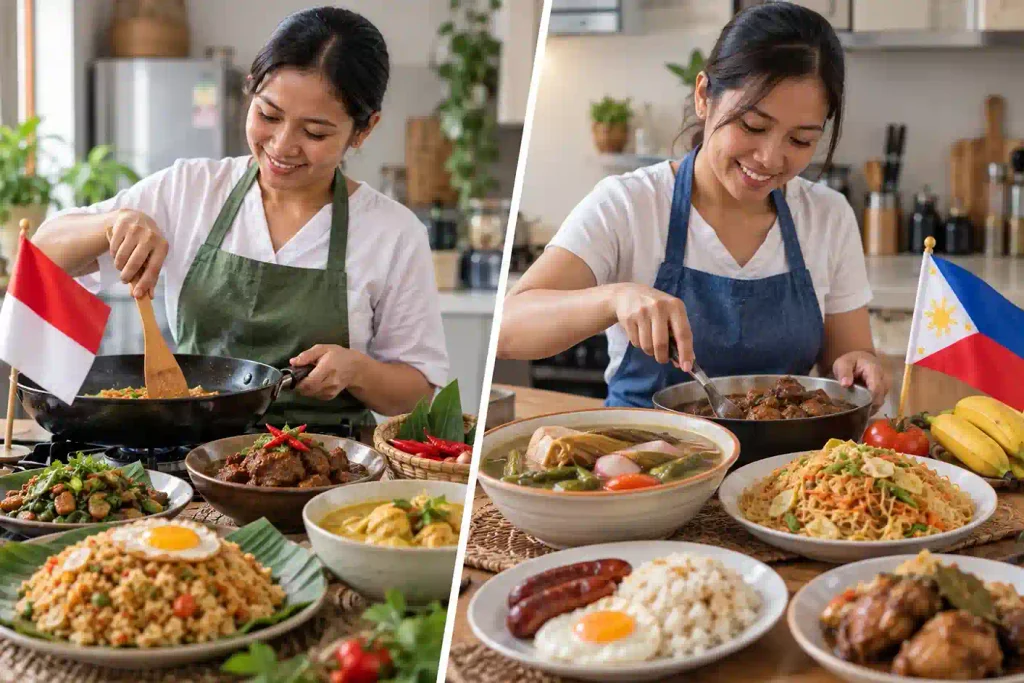
Food can be one of the most interesting differences between Indonesian and Filipino helpers.
MOM itself notes that MDWs may be accustomed to different foods because of their cultural background and gives Indonesian and Filipino cuisine as examples of cuisines employers can learn about.
Indonesian cuisine
For Singaporean families who enjoy spicy, rice-based or sambal-style food, an Indonesian helper with strong cooking experience may already be familiar with some flavours that are commonly enjoyed in Singapore.
However, don’t assume that every Indonesian helper can cook Indonesian food well. Some may have little cooking experience, while others may have extensive experience preparing both Indonesian and Singaporean meals.
Filipino cuisine
MOM describes Filipino cuisine as having vibrant flavours and influences from Spanish and American culinary traditions, and gives adsilog and champorado as examples.
Filipino helpers may also have experience preparing Western-style meals depending on their previous employment.
What if you want Singaporean food?
This is where interviewing matters more than nationality. If your family eats mostly Chinese food or Cantonese food, ask the candidate what she has actually cooked before.
A helper who has worked for a Singaporean family for several years may be much more familiar with local food than a first-time helper from either country.
3. Religion and Dietary Requirements
Religion can be an important consideration, particularly when it affects food preparation, prayer or household routines.
Indonesia is predominantly Muslim, although it has significant Christian communities and other religious groups.
The Philippines, meanwhile, has a predominantly Christian population, although it also has Muslim communities and other religious groups.
For employers, the practical point is not to assume a helper’s religion purely from her nationality.
If your family keeps a halal kitchen, for example, ask an Indonesian candidate directly about her dietary requirements and whether she is comfortable preparing and handling the food your household eats.
4. Cultural Differences You May Notice at Home
The biggest cultural differences may appear in everyday household routines rather than major cultural events.
For example, an Indonesian helper may be accustomed to:
- Rice-based meals several times a day
- Spicier food
- Sambal and chilli-based dishes
- Certain halal dietary practices if she is Muslim
- Bahasa Indonesia as her main language
A Filipino helper may be more accustomed to:
- Rice-based meals alongside meat or fish
- Dishes such as adobo, sinigang and pancit
- Filipino or English-language communication
- Christian religious traditions if she is Christian
These are broad cultural examples, not rules about individual helpers.
5. Cooking for Children
If you have young children, don’t simply ask “Can you cook?”
Instead, ask what she has actually prepared for children.
An Indonesian candidate might be familiar with making simple dishes such as chicken soup, fried rice, porridge or vegetable dishes, while a Filipino candidate might have experience with soups, rice meals, noodles and dishes such as tinola.
But these examples should only be used as conversation starters.
Ask:
- What did you usually cook for your previous employer’s children?
- Can you prepare less spicy food?
- Can you follow a recipe?
- Can you prepare food for a toddler?
- Are you comfortable learning new dishes?
- Can you prepare meals without using too much salt or sugar?
A helper’s ability to adapt her cooking to your family’s needs can be more important than her knowledge of traditional dishes.
6. Caring for Elderly Family Members

If your main reason for hiring a helper is elderly care, nationality should take a back seat to relevant caregiving experience.
For example, ask whether the candidate has experience with:
- Helping an elderly person walk
- Preparing meals
- Bathing and personal care
- Accompanying someone to medical appointments
- Supporting medication routines
- Caring for someone with limited mobility
- Communicating with someone who speaks a Chinese dialect
Language can become particularly important here.
An Indonesian helper may have learned some Hokkien or other local expressions from previous elderly-care work. There are documented examples of Indonesian MDWs learning Hokkien specifically to communicate with elderly employers.
A Filipino helper with similar experience may also have learned local languages or dialects from previous employers.
7. Familiarity With Singaporean Households
Previous Singapore experience can make the adjustment easier because the helper may already understand certain local routines.
For example, a helper who has previously worked in Singapore may already know how to:
- Use Singapore supermarkets
- Take public transport
- Shop at wet markets
- Handle common household appliances
- Follow local household routines
- Prepare commonly eaten Singaporean dishes
This applies to both Indonesian and Filipino helpers.
A first-time helper may need more guidance regardless of nationality. MOM’s own resources emphasise that helpers may need time to adjust to new food, languages and ways of living.
8. Communication Style and Household Hierarchy
Another difference employers may notice is communication style.
Some helpers may be naturally quiet or hesitant to ask questions when they are unfamiliar with a new employer. Others may be more direct and comfortable speaking up.
This should not automatically be interpreted as a cultural characteristic. A better approach is to explain your expectations clearly:“If you don’t understand something, please ask me.”
This is especially important during the first few weeks.
Which Is Better for a Muslim Household?
If your household follows halal dietary requirements, an Indonesian helper may sometimes be easier to match with your lifestyle because Indonesia has a large Muslim population.
However, this does not mean every Indonesian helper is Muslim, and it does not mean Filipino helpers cannot work comfortably in a Muslim household.
The practical approach is to ask candidates directly about:
- Halal food
- Pork and alcohol handling
- Prayer
- Ramadan
- Food preparation
- Household expectations
Your family’s requirements and the individual candidate’s practices should determine compatibility.
Which Is Better for a Family With Young Children?
There is no nationality-based answer.
Instead, compare candidates according to childcare experience, communication, patience, safety awareness, cooking, and previous employer’s requirements.
For example, a Filipino candidate with five years of childcare experience may be a better match for one family, while an Indonesian candidate with extensive newborn-care experience may be better suited to another.
The important thing is to compare experience with your specific situation.
Indonesian Maid vs Filipino Maid: Which Should You Choose?
Rather than choosing a nationality first, start by identifying your family’s priorities.
An Indonesian helper may be worth considering if:
- You prefer Indonesian or Malay-style cuisine
- Halal food is important to your household and the individual candidate follows halal practices
- You are comfortable communicating in Bahasa Indonesia or simple English
- You want someone with relevant experience in Indonesian or Singaporean households
- You prefer a candidate familiar with Southeast Asian household routines
A Filipino helper may be worth considering if:
- English communication is particularly important to your household
- You prefer Filipino or Western-influenced cuisine
- You have a candidate with strong childcare or household-management experience
- Your family communicates primarily in English
- The candidate’s previous experience closely matches your household needs
These are selection considerations, not guarantees. The individual helper’s skills and experience should ultimately be evaluated during the interview.
Also Read: Living With an Indonesian Maid in Singapore: What Employers Should Know
Looking for an Indonesian Maid Agency in Singapore?
If you have decided that an Indonesian helper may be a good fit for your household, choosing an experienced Indonesian maid hiring agency can make the search more straightforward.
At Jaya Maids, we specialise in helping Singapore families hire full-time Indonesian and Myanmar domestic helpers. Our team can help you explore Indonesian maid candidates based on the specific needs of your household, including childcare, elderly care, cooking and general housekeeping.
Whether you are specifically searching for an Indonesia maid agency, an Indonesian helper agency, or an agency that can help you compare suitable candidates, we can assist you through the hiring process.
Instead of choosing based on nationality alone between Indonesian maid vs Filipino maid, tell us what your family needs.
Jaya Maids can help you find an Indonesian domestic helper whose experience and skills match your household requirements.
